Diastasis and umbilical hernia: why they so often go together
A weakened linea alba is more exposed at the navel, where the wall is naturally thinner, so a true umbilical hernia frequently opens within a diastasis. The distinction matters more than the measurement: a diastasis is a stretched but continuous band, a hernia is an opening through which content can protrude. Where the two coexist, guidelines suggest a mesh-based repair rather than plication alone.
Why the navel is the weak spot
The umbilicus is a scar, and an old one: it is where the vessels of the umbilical cord passed through the wall before birth. At that point the linea alba is naturally thinner and less regular than along the rest of its course.
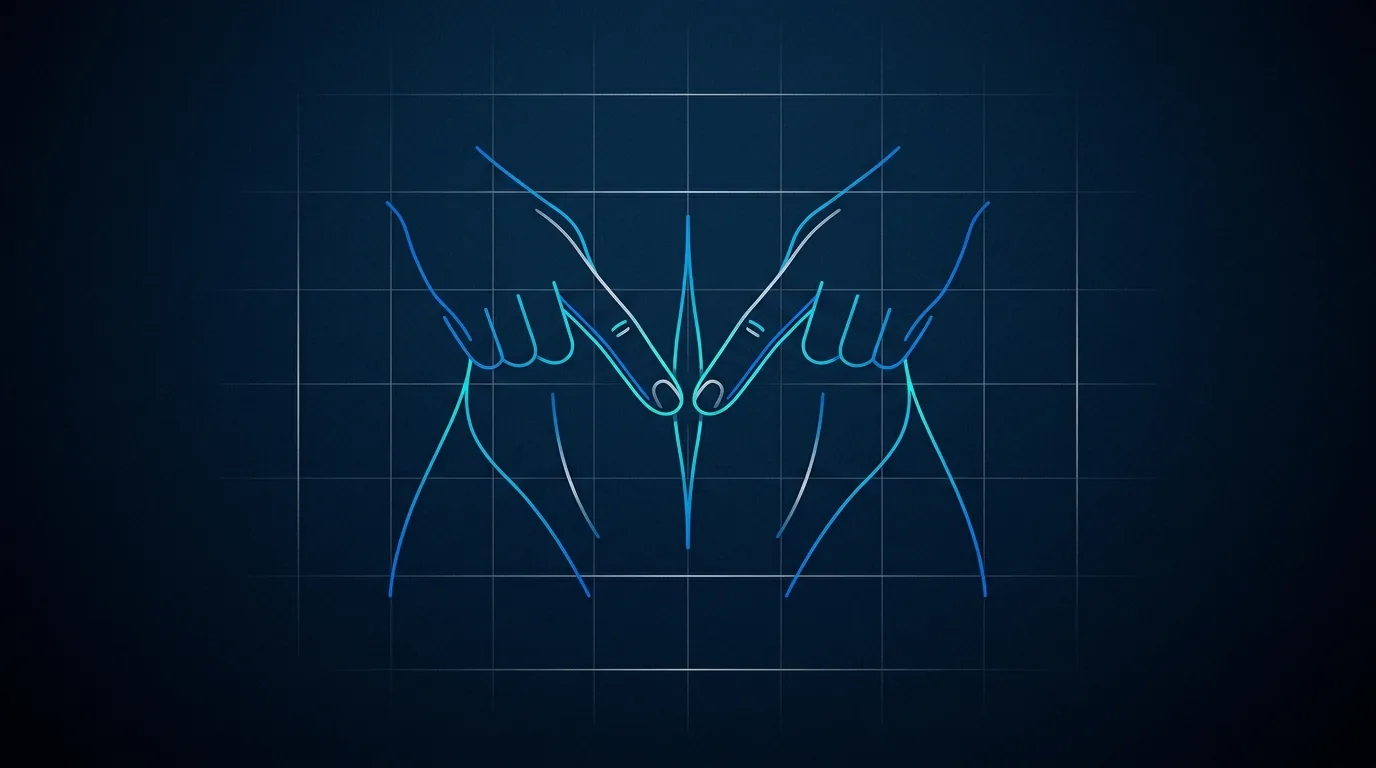
A diastasis widens and thins that same band. What was already the most fragile point of the midline becomes more fragile still, and pressure from within finds it.
This is why the combination is common rather than surprising, and why an assessment of a diastasis that does not palpate the navel specifically has missed the most likely additional finding.
How the two are told apart
In a diastasis the band between the rectus muscles is stretched but continuous: pressing along the midline finds a soft, wide gap without a defined edge. In a hernia there is a discrete opening with a palpable rim, and content that protrudes through it and can often be reduced.
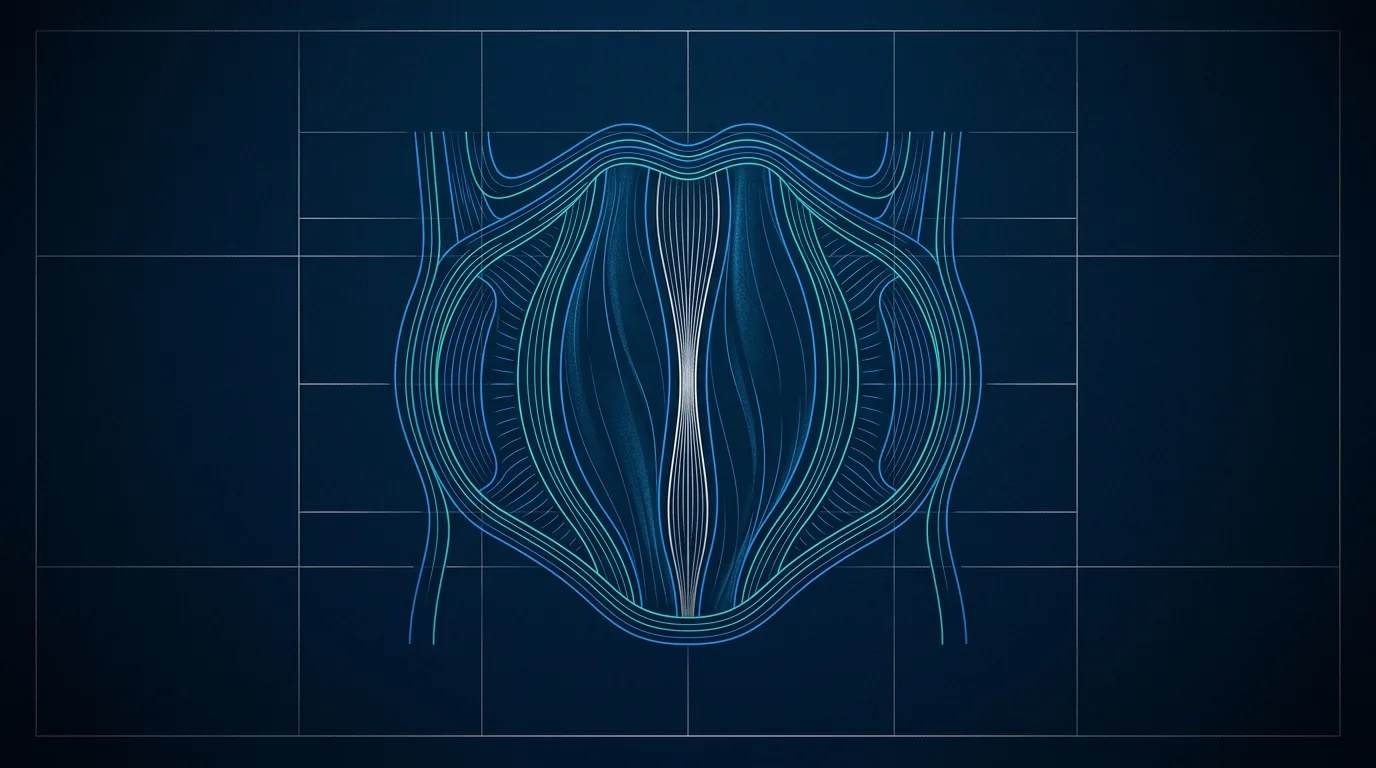
The behaviour differs as well. A diastasis produces an elongated ridge along the midline when the abdomen contracts; a hernia produces a rounder, more localised lump that appears on coughing or standing and flattens when lying down.
Where the examination leaves doubt, ultrasound of the wall answers the question, provided the request states what is being looked for. A report that mentions only the inter-recti distance does not settle it.
Why the combination changes the repair
Guidance on rectus diastasis suggests plication of the linea alba in patients without a concomitant hernia, and a mesh-based repair where a hernia is present alongside the diastasis (British Journal of Surgery 2021 — DOI 10.1093/bjs/znab128).
There is a straightforward reason. Stitching together tissue that has already given way, across a defect, leaves the repair carrying tension it may not hold. A mesh distributes that tension over a wider area.
The combination also strengthens the case for operating at all. In men, the association that reached significance at the 3 cm threshold was precisely the one with hernia, while no association was found with low back pain or quality of life (Hernia 2024 — DOI 10.1007/s10029-024-03225-3).
What to establish before deciding
The order of the questions is what makes an assessment useful, and it is the same whether the conclusion is conservative or surgical.
- whether a hernia is present alongside the diastasis, and where exactly;
- the size of the hernial defect, which weighs more in the decision than the width of the separation;
- whether more than one defect sits along the midline, since satellite defects missed at surgery reappear afterwards;
- what the plan is for the skin, if there is excess, because a wall repair does not remove it;
- which symptoms are expected to improve, and which have other possible causes.
Also worth reading
Sources
- Hernández-Granados P, et al. European Hernia Society guidelines on management of rectus diastasis. British Journal of Surgery 2021 — DOI 10.1093/bjs/znab128
- Prevalence, risk factors, and adverse outcomes of diastasis of rectus abdominis in men: a cross-sectional study. Hernia 2024 — DOI 10.1007/s10029-024-03225-3
Frequently asked questions
- Can a diastasis turn into a hernia?
- A diastasis does not become a hernia, because the two are different things: one is a stretched but continuous band, the other an opening in the fascia. What does happen is that a hernia opens within a diastasis, most often at the navel, where the linea alba is naturally thinnest.
- How is a small umbilical hernia recognised?
- Usually as a rounder, localised lump at or beside the navel that appears on coughing or standing and flattens when lying down, with a palpable rim on examination. Where the examination leaves doubt, ultrasound of the wall settles it, provided the request specifies the search for a hernial defect.
- Does the presence of a hernia mean surgery is necessary?
- It makes the indication considerably clearer, because a hernia is a true defect that can enlarge and, uncommonly, incarcerate. It does not make it automatic: size, symptoms and general condition still weigh in the decision, and a small asymptomatic hernia can be observed.
- Why is a mesh suggested when the two coexist?
- Because stitching together tissue that has already given way, across a defect, leaves the repair under tension it may not hold. A mesh distributes that tension over a wider area. Guidance suggests plication alone only in the absence of a concomitant hernia.
People also ask
- What is diastasis recti?
- What are the symptoms of diastasis recti?
- How do you check for diastasis recti at home?
- When does diastasis recti need surgery?
- How is diastasis recti diagnosed?
Published on: 2026-08-21 · Content by Dr. Federico Fiori